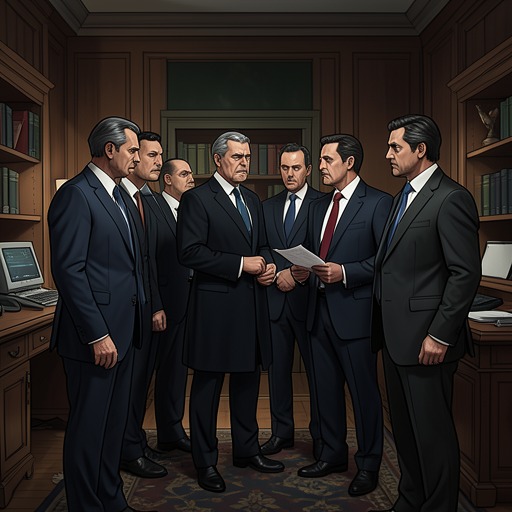
Anton Antonovich Skvoznik-Dmukhanovsky
The Government InspectorAnton Antonovich Skvoznik-Dmukhanovsky is the Governor of the provincial town in The Government Inspector, a local ruler whose official authority serves private advantage. When news arrives that an inspector is coming incognito from Saint Petersburg, he responds not by correcting the abuses in his district but by trying to control what the inspector can learn. His panic, self-justification, and hunger for higher rank make him both a comic character and a vivid embodiment of the play’s corrupt administrative world.
Identity and Position
Anton Antonovich occupies the highest local office represented in the play. His power reaches down through the town administration, and his subordinates are expected to obey him; he can threaten consequences for anyone who fails to give the visiting official a favorable report. The play’s wider framing presents the town’s petty governors as near-despot rulers, able to regulate extortion and persecution at their own discretion. Anton Antonovich gives that general portrait a particular face: he treats public office less as a duty than as control over people, information, and goods.
The threat to his position comes in the form of a secret inspection. At a meeting with the town officials, he announces that a Government Inspector is expected, then specifies that the visitor is from Saint Petersburg, is traveling incognito, and carries secret instructions. A letter has warned him that an official is to inspect the government, especially the district. Anton Antonovich also recalls dreaming of two enormous black rats that entered, sniffed about, and left. The dream does not explain the inspection, but its monstrous visitors echo the menace he already feels in the news.
Managing the Inspection
His first response is to search for information that might reveal whether the town has been denounced. He privately asks the postmaster to open letters passing through the office, read them for damaging reports, and either reseal them or deliver them already opened. Anton Antonovich presents this intrusion as being for the common benefit, but the immediate purpose is to protect himself. The postmaster admits that he already opens letters out of curiosity, so the Governor’s request turns an existing breach of privacy into a possible instrument of official surveillance.
He also orders a hurried transformation of appearances. A tall sergeant is to stand on duty at the bridge; an old fence near a bootmaker’s is to be torn down, with a post and a wisp of straw put in place to suggest road work. The debris already piled against the fence—about forty cartloads—becomes, in his mind, something that might make the Governor’s activity look more visible. The town’s disorder is not remedied; it is rearranged into a display. He instructs the officials to say that they are perfectly satisfied, and threatens anyone who gives a different answer with later punishment. Even as he calls himself a terrible sinner, he plans to levy a large quantity of wax from each merchant for a candle if the crisis passes. After issuing these orders, he takes a hat-box instead of his hat, a small but telling sign of how thoroughly alarm has unsettled him.
When speaking to the supposed inspector, Anton Antonovich reverses the truth into a claim of administrative virtue. He says that the authorities in other towns look out for themselves, whereas his own officials think only of winning the Government’s esteem through order, vigilance, and efficiency. That polished account stands against the preparations he has just made: coerced testimony, cosmetic repairs, and private efforts to intercept correspondence. His performance depends on the belief that a convincing report can substitute for an honest one.
Power and the Townspeople
The merchants’ account exposes what the Governor’s official presentation conceals. They describe soldiers quartered on them, goods taken from their shops, and pressure to supply clothing for his wife and daughter. One merchant recalls Anton Antonovich taking hold of his beard and insulting him, then demanding a length of cloth that came to nearly forty yards. The complaint depicts exploitation as routine and personal: the Governor uses his authority not only to extract resources but to make those subject to him endure humiliation.
The merchants’ testimony also contradicts Anton Antonovich’s own explanation of his conduct. He tells the postmaster that, if he has taken from people, he did so without ill feeling; the merchants describe repeated injuries and uncompensated taking. Their account shifts the focus from his self-image to the effects of his rule. In the play’s larger satirical frame, the Governor’s private abuses are not isolated lapses: they help reveal how local authority can turn public office into a mechanism for personal extraction.
Ambition and Exposure
Anton Antonovich’s fear of inspection is joined to an appetite for advancement. Once he believes the visitor is closely connected to ministers and the court, he asks whether this association might raise him to a high rank and eventually make him a general. The imagined route upward matters as much as the immediate danger: rather than questioning the prestige system that governs his ambitions, he sees proximity to power as a chance to leave his present station behind.
That confidence breaks when the deception is exposed. Beating his forehead, he asks how the officials could have been so off guard and calls himself foolish. He recalls thirty years in service and boasts of having outmaneuvered merchants, contractors, swindlers, and even three governor-generals. The contrast is sharp: the man who has made a career of detecting and exploiting other people’s weaknesses cannot recognize the fraud before him. His experience, far from protecting him, becomes part of the humiliation, because he had taken past success as proof that he could not be fooled.
Narrative and Social Significance
Anton Antonovich concentrates the play’s tension between official rank and actual conduct. He can command subordinates, punish unsatisfactory reports, and interfere with private correspondence, yet he cannot control the information that finally undoes him. His responses to the inspection—surveillance, staged improvements, forced assurances, and a sudden hope of promotion—show authority working defensively, in service of the officeholder rather than the governed.
The play’s critical force extends beyond a portrait of one bad official. Gogol’s own stated conception emphasized exposing individuals and their actions, but the work came to be received as a satire of the system that produced them. Anton Antonovich makes that distinction difficult to sustain: his personal greed is visible in each taking, while the reach of his office enables it. At the first production in April 1836, Nicholas I was present and reportedly remarked that everyone had been satirized, himself included. The Governor’s downfall thus carries a larger irony: the official who claims to serve the Government’s esteem becomes the figure through whom the play lays bare the abuses of local government.